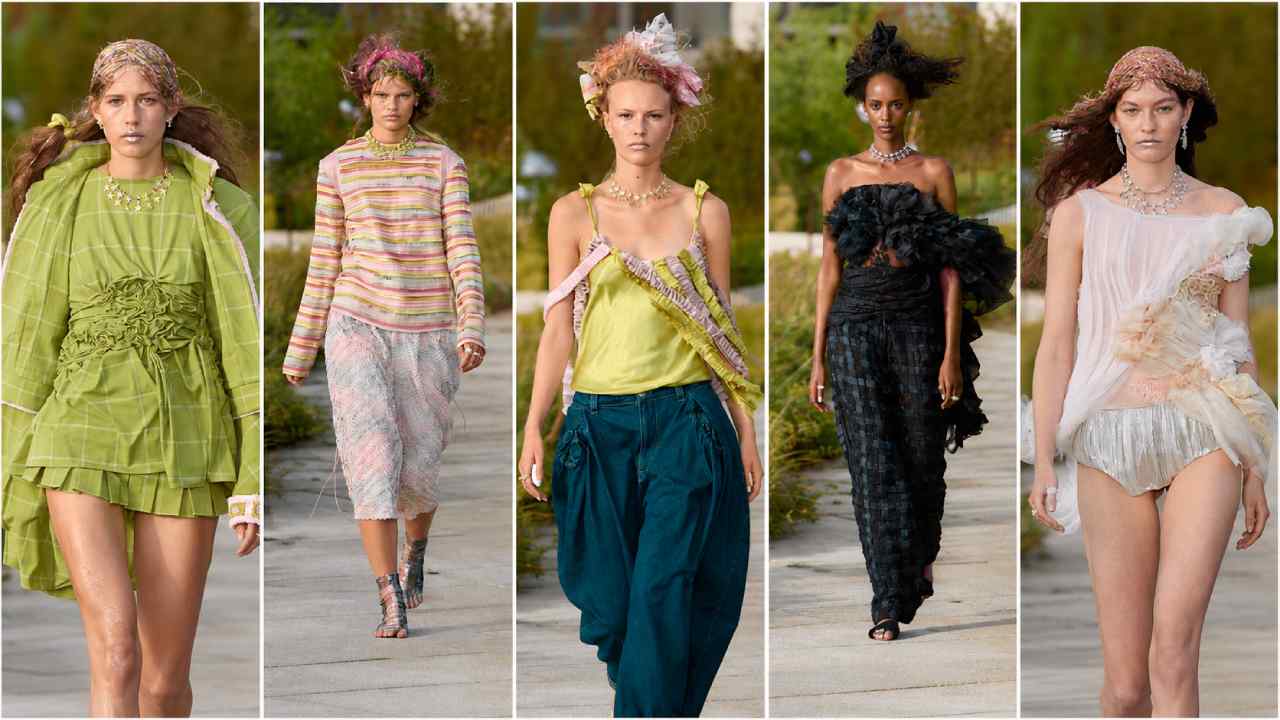
Beauty Rival – What happens when a designer stops searching for new fabric and starts looking at what is already there? For Collina Strada, the answer became a colorful runway story in Copenhagen. The New York label presented its Pre-Spring 2027 collection, “Delirium in Bloom,” during Copenhagen Fashion Week. Instead of treating leftover materials as a limitation, designer Hillary Taymour used them as a creative starting point. The collection relied on deadstock materials already available in the studio. From there, fabric was gathered, layered, twisted, pleated, and reshaped into expressive garments. As a result, sustainability became part of the design process rather than an extra message added afterward. The approach also suited Collina Strada’s established personality. The brand has long favored experimentation over polished uniformity. However, this collection brought a noticeably softer mood into that world. Dreamy fabrics and romantic colors appeared alongside the playful details that continue to define the label.
Read Also: Copenhagen Fashion Week Spring 2027 Introduces the Rise of Opposition Dressing
Copenhagen Gives the Collection a Different Kind of Stage
The setting helped shape that softer atmosphere. Rather than presenting the collection in New York, Collina Strada arrived in Copenhagen as an official global guest during the city’s fashion week. The show took place near the water at Operaparken on August 6, 2026. Copenhagen Fashion Week itself ran from August 3 through August 7 and marked its 20th anniversary this season. Therefore, the appearance carried significance beyond a standard runway slot. Models walked through an outdoor setting as evening approached, creating a more atmospheric backdrop for the collection. A string quartet added another layer of contrast to the label’s eccentric visual language. Meanwhile, barefoot styling, glitter, and tinsel prevented the presentation from becoming overly formal. This combination worked because Copenhagen and Collina Strada share an interest in questioning conventional fashion. Yet, they often express that idea differently. Copenhagen has built a strong sustainability identity, while Collina Strada approaches fashion through colorful experimentation and irreverent styling.
Deadstock Becomes a Creative Tool Instead of a Compromise
Sustainable fashion often raises a difficult question: can designers reduce material waste without reducing creative freedom? Here, Collina Strada Turns that challenge into part of the collection’s identity. Deadstock refers to unused or leftover fabric that already exists rather than material produced specifically for a new collection. Working with it can create practical limitations. Designers may have only small quantities of a particular textile, and replacing it later may be impossible. However, those restrictions can also encourage different decisions. Instead of forcing every garment into a predetermined idea, the available material can influence the final form. Collina Strada embraced that uncertainty through patchworking, sculpting, gathering, and layered construction. Consequently, irregularity became visually useful. A limited piece of fabric did not necessarily need to become a complete conventional garment. It could become one section within a more complex design. That approach makes sustainability feel connected to creativity rather than presented as a separate responsibility.
Delirium in Bloom Reveals a Softer Side of Maximalism
Collina Strada is rarely associated with quiet fashion. The brand’s identity often includes unexpected proportions, playful styling, unusual textures, and deliberately chaotic combinations. Nevertheless, “Delirium in Bloom” introduced a more romantic tone without abandoning that recognizable energy. Flowing chiffon brought movement, while shades of pink, green, and blue created a softer visual rhythm. Glittering bras, sequined pieces, and practical cargo shorts then disrupted the sweetness. Consequently, the collection never became traditionally romantic. Instead, femininity appeared slightly strange, playful, and imperfect. That distinction matters because maximalism does not always require louder colors or more decoration. Sometimes, it comes from layering ideas that would normally remain separate. Delicate fabrics can sit beside utilitarian shapes. Sparkle can appear with relaxed silhouettes. Likewise, softness can coexist with humor. The collection demonstrated this balance repeatedly. Rather than replacing Collina Strada’s eccentricity, the dreamy mood gave that eccentricity another direction in which to grow.
Fabric Manipulation Gives Old Materials New Character
Using existing material is only the beginning. The more interesting question is how a designer makes that material feel new. Collina Strada approached the problem through physical transformation. Pleating changes how fabric catches light. Gathering creates volume, while twisting can disrupt an otherwise familiar silhouette. Patchwork allows smaller pieces to become part of a larger composition. Meanwhile, sculpting can give lightweight textiles unexpected structure. Together, these techniques help explain why deadstock does not have to produce clothing that looks recycled in an obvious way. The final garment can develop an identity completely different from the material’s original purpose. Moreover, this process introduces a human quality that suits Collina Strada. Small irregularities become part of the design rather than flaws that need to disappear. In an industry often built around consistency, that approach feels refreshing. It also demonstrates a practical lesson about sustainable design: reducing new material use can encourage experimentation when designers treat limitations as creative information.
Read Also: Kaia Gerber Turns Heads with a Chic Side Part Hairstyle
New York Energy Meets Copenhagen’s Sustainable Fashion Culture
The cultural contrast behind the show adds another layer to the story. Collina Strada comes from New York, where its colorful and unconventional aesthetic has developed within a fast-moving fashion environment. Copenhagen, meanwhile, has become increasingly associated with sustainability standards and experimental Scandinavian style. Bringing the two together creates an interesting conversation. Collina Strada Turns sustainable restrictions into maximalist possibilities rather than adopting Scandinavian minimalism. Therefore, the brand did not need to change its personality to fit Copenhagen. Instead, it found common ground through responsible material choices. This distinction is important. Sustainable fashion does not have to follow one visual language. It can be restrained, colorful, romantic, strange, or theatrical. What matters is how materials and production decisions are handled. Collina Strada’s appearance offered a useful example of that idea. The collection remained unmistakably connected to Taymour’s creative world while responding naturally to Copenhagen Fashion Week’s stronger environmental expectations.
The Runway Shows Why Sustainability Needs Personality
Fashion audiences have heard sustainability claims for years. As a result, broad environmental language alone may no longer feel especially memorable. Design still needs personality. This is where Collina Strada’s approach becomes more interesting. The collection did not ask viewers to admire deadstock simply because it was deadstock. Instead, the material became part of garments designed to attract attention on their own. That difference can make sustainability more engaging. A customer may first notice an unusual silhouette, delicate chiffon, or playful combination of textures. Only afterward does the material story add another layer of meaning. Moreover, this approach avoids presenting responsible fashion as a sacrifice in style. The clothes can still be imaginative and visually ambitious. Of course, one runway collection cannot solve the fashion industry’s wider environmental challenges. However, creative examples can influence how designers and consumers think about existing resources. When leftover material becomes desirable fashion, waste starts to look less like an endpoint and more like unused creative potential.
Collina Strada Turns Constraint Into Fashion With Character
The strongest idea behind “Delirium in Bloom” is surprisingly simple: creativity does not always begin with unlimited choice. Sometimes, restrictions produce the most interesting questions. What can be made from fabric already sitting in a studio? How can small pieces become useful again? Can sustainability remain playful rather than serious and predictable? In Copenhagen, Collina Strada Turns those questions into clothing filled with movement, color, texture, and personality. The result connects several parts of the brand’s identity at once. There is the familiar maximalism, but it feels softer. There is environmental thinking, yet it does not dominate the visual story. Finally, there is experimentation driven by material limitations rather than hidden by them. That combination gives the collection relevance beyond one fashion week. As designers continue searching for ways to use resources more thoughtfully, deadstock may become more than leftover inventory. In the right hands, it can become the first chapter of an entirely new design.