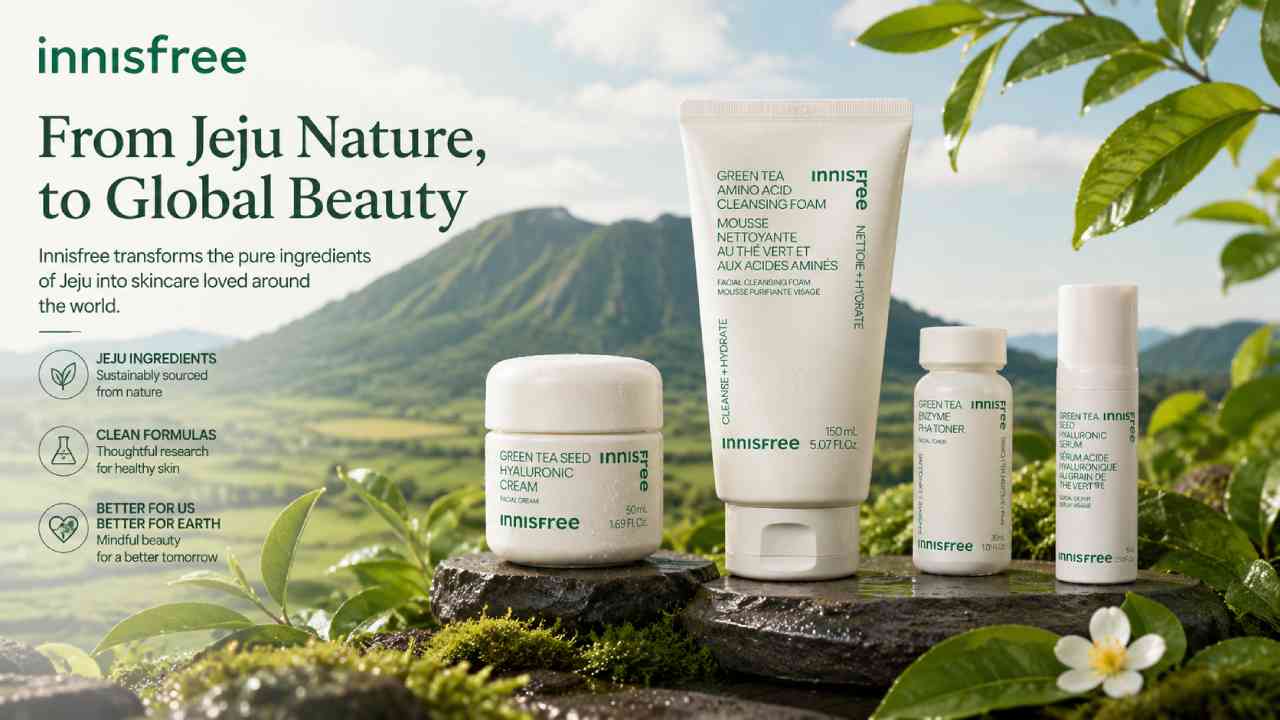
Beauty Rival – Innisfree has built a recognizable skincare identity by connecting Korean ingredients, scientific research, and the landscape of Jeju Island. Since its launch in 2000, the Korean beauty brand has repeatedly returned to Jeju as an important part of its story. Green tea became especially significant, but it was not the only ingredient associated with the island. Volcanic materials and several botanical ingredients also became part of its product language. As K-beauty expanded internationally, this connection helped the brand stand apart in an increasingly crowded skincare market. However, its development is more complex than simply placing natural ingredients inside attractive packaging. The company gradually combined botanical storytelling with modern formulation techniques. Consequently, its identity evolved alongside consumers who became more interested in ingredients, hydration, skin barriers, and product performance. That balance between place, nature, and skincare research remains one of the most interesting parts of the brand’s global story.
Read Also: The Simple Foot Care Routine for Softer, Smoother Feet
Jeju Became More Than a Beautiful Marketing Background
Jeju Island occupies a central position in the brand’s visual and ingredient storytelling. The relationship extends beyond photographs of green fields and volcanic landscapes. The company’s wider history with tea cultivation on Jeju dates back decades, while the skincare brand later incorporated that heritage into its product development. This gave Innisfree something valuable: a recognizable geographical identity. Many skincare companies can formulate products with green tea. However, connecting an ingredient to a specific landscape creates a richer story. Consumers can associate the formula with a place, cultivation process, and cultural context. Moreover, Jeju provides several visual themes that work naturally within beauty branding, including greenery, water, volcanic terrain, and botanical cultivation. Nevertheless, location alone cannot sustain a skincare company. Products still need suitable formulations and clear functions. Therefore, Jeju works best as a foundation for the brand’s identity rather than a substitute for product development.
Green Tea Became One of the Brand’s Signature Ingredients
Few ingredients are as closely connected with Innisfree as green tea. The brand introduced its Jeju Green Tea line in 2008 and continued developing the ingredient for skincare applications. According to its brand history, research eventually led to a variety known as Beauty Green Tea. It was selected and developed with skincare use in mind. This approach demonstrates how a familiar botanical ingredient can become distinctive through long-term product development. Green tea itself is hardly rare in cosmetics. It appears across cleansers, serums, creams, and masks from many companies. Yet Innisfree made it part of a broader narrative involving Jeju cultivation and hydration-focused skincare. As a result, consumers often recognize the ingredient as part of the brand rather than simply another item on an ingredient list. From a branding perspective, that consistency matters. Repeated association can transform a common ingredient into a recognizable signature.
The Ingredient Story Expanded Beyond Green Tea
Although green tea remains highly recognizable, the brand gradually explored other Jeju-linked materials. These have included volcanic material, Bija, cherry blossom, and black tea. Each ingredient allowed different skincare concerns to sit within the same broader brand world. For example, volcanic materials became strongly associated with products designed for excess oil and impurities. Meanwhile, botanical ingredients supported hydration and other skincare categories. This strategy helped Innisfree expand its product range without completely abandoning its original identity. Instead of introducing unrelated concepts for every launch, the brand could return to the idea of Jeju and reinterpret it through different formulas. However, consumers should still evaluate products individually. A natural origin does not automatically make an ingredient more effective or suitable for every skin type. Formula concentration, supporting ingredients, texture, and personal sensitivity all matter. That distinction is especially important as skincare consumers become more knowledgeable about cosmetic formulations.
Nature and Skincare Science Now Work Together
Modern skincare consumers often expect more than a romantic story about botanical ingredients. They want to understand what a product contains and how it fits into a routine. Therefore, Innisfree has increasingly presented nature alongside Korean skincare technology and formulation research. This evolution reflects a broader shift across the beauty industry. Terms such as ceramides, peptides, hyaluronic acid, skin barrier, and active ingredients are now familiar to everyday consumers. Botanical storytelling must exist alongside this growing ingredient literacy. Innisfree’s current direction demonstrates how an established nature-focused brand can respond without abandoning its roots. Instead of treating science and nature as opposing ideas, the two can complement each other. A botanical ingredient can provide part of the product story, while modern formulation determines how the complete product behaves on the skin. In my view, this combination gives natural skincare branding more credibility than relying on vague claims about purity alone.
Modern Formulas Show How the Brand Has Evolved
The evolution becomes clearer when looking at newer formulations. Green tea can remain the recognizable hero ingredient while other components support hydration and barrier care. Modern moisturizers, for example, may combine botanical extracts with ingredients such as hyaluronic acid, squalane, or ceramides. This layered approach reflects how skincare formulation has changed. Consumers increasingly expect products to address specific needs rather than depend on a single fashionable ingredient. Consequently, Innisfree can preserve the emotional familiarity of green tea while adapting its formulas to current expectations. This is an important lesson for established beauty brands. Heritage becomes more useful when it can evolve. If a company relies only on nostalgia, younger consumers may eventually move toward more innovative competitors. On the other hand, abandoning a recognizable identity can make a brand feel generic. Combining familiar ingredients with updated formulations offers a middle path between those two extremes.
Global K-Beauty Growth Gave the Story a Wider Audience
The international rise of Korean beauty created an ideal environment for brands with distinctive Korean identities. Innisfree began expanding beyond South Korea years ago, entering markets across Asia and other regions as interest in K-beauty accelerated. This expansion introduced more consumers to ideas that were becoming associated with Korean skincare, including layered hydration, gentle cleansing, essences, masks, and daily sun protection. However, international growth also created greater competition. Consumers could suddenly choose from a much wider selection of Korean brands. Therefore, having a recognizable story became increasingly valuable. Jeju offered Innisfree an identity that could travel across borders without requiring consumers to understand every detail of Korean beauty culture. Green landscapes, tea cultivation, and botanical ingredients are visually accessible concepts. At the same time, the Korean origin provided additional relevance as global interest in K-beauty continued to grow.
Packaging Helps Translate Jeju Into a Visual Language
Ingredients tell only part of a skincare story. Packaging also influences how consumers understand a brand before they ever apply the product. Over the years, Innisfree has frequently used visual cues connected with green tea, plants, earth, and clean natural environments. Greens, neutral tones, simple shapes, and ingredient-focused imagery have helped translate the Jeju concept into a recognizable visual language. However, modern beauty packaging also needs to compete on crowded retail shelves and digital marketplaces. A product may appear as a small image on a smartphone screen before a customer sees it physically. Therefore, clear hierarchy and recognizable branding have become increasingly important. The strongest packaging does not need to explain the entire brand story at once. Instead, it should create enough consistency that customers can identify the brand quickly. When packaging, ingredients, and storytelling reinforce one another, the overall identity becomes easier to remember.
Read Also: The Biggest Fall Sweater Trends Taking Over 2026
Natural Does Not Automatically Mean Better for Every Skin Type
The popularity of botanical skincare sometimes creates an important misconception: natural ingredients are automatically gentle or universally suitable. In reality, skin can react to both naturally derived and synthetic ingredients. Fragrance, botanical extracts, essential oils, preservatives, and active ingredients may affect individuals differently. Therefore, consumers should evaluate Innisfree products according to the complete formula and their personal skin needs rather than the natural image alone. Someone with sensitive skin, for instance, may prefer fragrance-free options or perform a patch test before introducing a new formula. Likewise, people dealing with persistent skin concerns may benefit from professional dermatological advice. This balanced approach does not diminish the value of botanical ingredients. Instead, it places them within realistic skincare expectations. Good skincare is rarely about finding one magical ingredient. More often, it involves consistent cleansing, adequate moisturization, sun protection, and carefully selected treatments that suit the individual.
Innisfree Shows Why Ingredient Storytelling Can Be Powerful
One of the strongest lessons from Innisfree is how an ingredient can become much more than a line on the packaging. Green tea gains additional meaning when consumers connect it with Jeju, cultivation, research, hydration, and a long-running product family. Volcanic material can similarly become recognizable when its origin and purpose remain consistent across products. This is effective storytelling because it helps customers organize a large skincare catalog mentally. Instead of remembering dozens of unrelated product names, they can remember ingredient families and their general purposes. Still, storytelling works best when it remains connected to useful products. Consumers today can compare ingredient lists, watch dermatologist commentary, read reviews, and research alternatives within minutes. Therefore, branding cannot permanently compensate for weak product experiences. The story may attract initial attention, but performance and suitability influence whether customers return. Successful beauty brands increasingly need both emotional identity and practical credibility.
A Korean Skincare Identity That Continues to Evolve
The most interesting part of Innisfree is not simply that it uses ingredients associated with Korea. Its broader achievement is turning Jeju into a consistent framework for product development, packaging, and international storytelling. Green tea became a signature, while other botanical and volcanic ingredients expanded the brand’s vocabulary. Meanwhile, modern formulations allowed the company to participate in conversations about hydration, barrier support, and ingredient-focused skincare. This balance will remain important as beauty trends continue changing. Today’s consumers are often more skeptical of exaggerated claims and more willing to research what they put on their skin. Therefore, heritage alone is unlikely to be enough. Brands must continue demonstrating why familiar ingredients remain relevant. Innisfree’s challenge is the same one faced by many established beauty companies: preserve what people recognize while continuing to evolve. When that balance works, Korean natural ingredients become more than a trend. They become part of a lasting global skincare identity.